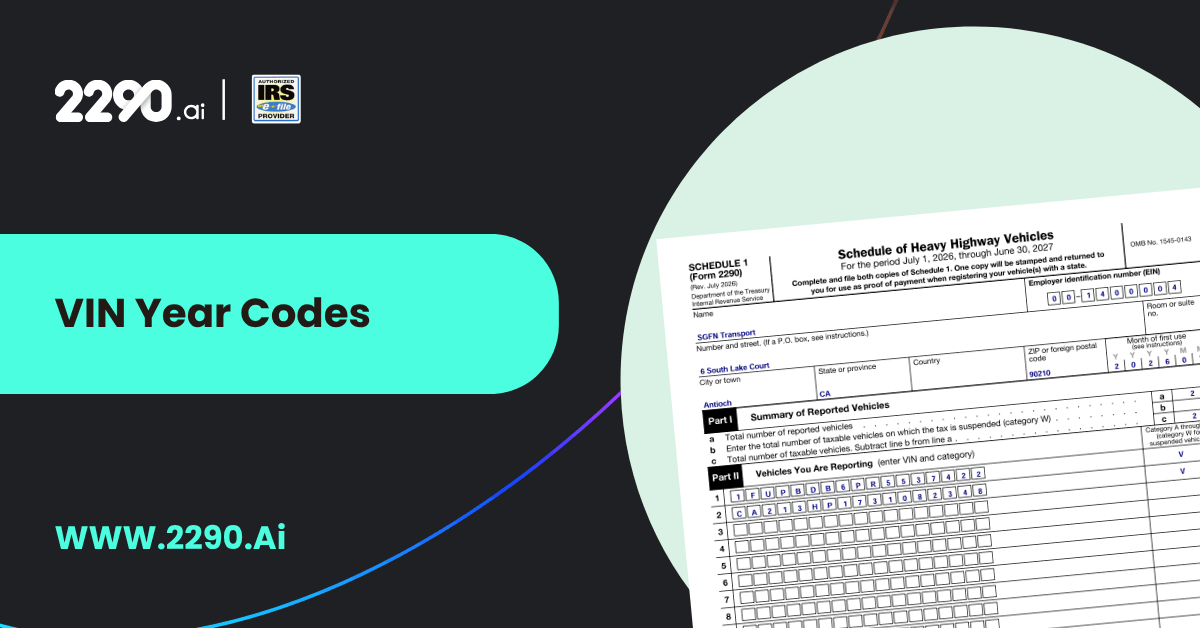
In a 17-character VIN, the model year is identified by the character in position 10. If it is X, the vehicle could be a 1999 or 2029 model because VIN year codes repeat every 30 years. The complete VIN, title, and registration can help identify the correct year.
This guide explains how to read VIN year codes, determine what X means when it appears in a VIN, and how this information matters when filing Form 2290.
What Year Is X in a VIN?
An X in the 10th position of a VIN can represent model year 1999 or 2029.
Because the coding sequence repeats, to pinpoint what year X is in a VIN, consider the vehicle title, registration, VIN information, and manufacturer or NHTSA database records.
| VIN Character | Position | Model Year |
|---|---|---|
| X | 10th | 1999 or 2029 |
Which VIN Character Tells You the Year?
Standard modern VINs consist of 17 characters. Each segment provides specific manufacturing details, such as the manufacturer, vehicle attributes, model year, assembly plant, and production sequence. The positions most relevant here are:
| VIN Position | Information |
|---|---|
| 9th character | Check digit |
| 10th character | Model year |
| 11th character | Manufacturing plant identifier |
For example, consider this 17-character sequence: 1ABCD1234X4567890. Counting from left to right, X is the 10th character. Therefore, X is the model-year code in this VIN.
If X appears in the 9th position of a valid VIN, it serves as the check digit.
Note: An X appearing elsewhere does not carry the same meaning.
VIN Year Code Chart
VIN model-year codes use a repeating 30-year sequence of letters and numbers, with certain letters omitted to avoid confusion with numbers. The VIN year chart below shows the codes and the two model years that each code can represent:
| VIN Code | Earlier Model Year | Later Model Year |
|---|---|---|
| A | 1980 | 2010 |
| B | 1981 | 2011 |
| C | 1982 | 2012 |
| D | 1983 | 2013 |
| E | 1984 | 2014 |
| F | 1985 | 2015 |
| G | 1986 | 2016 |
| H | 1987 | 2017 |
| J | 1988 | 2018 |
| K | 1989 | 2019 |
| L | 1990 | 2020 |
| M | 1991 | 2021 |
| N | 1992 | 2022 |
| P | 1993 | 2023 |
| R | 1994 | 2024 |
| S | 1995 | 2025 |
| T | 1996 | 2026 |
| V | 1997 | 2027 |
| W | 1998 | 2028 |
| X | 1999 | 2029 |
| Y | 2000 | 2030 |
| 1 | 2001 | 2031 |
| 2 | 2002 | 2032 |
| 3 | 2003 | 2033 |
| 4 | 2004 | 2034 |
| 5 | 2005 | 2035 |
| 6 | 2006 | 2036 |
| 7 | 2007 | 2037 |
| 8 | 2008 | 2038 |
| 9 | 2009 | 2039 |
The above VIN model year chart makes the repeating sequence clear.
Why Can X Mean Both 1999 and 2029?
Since VIN model-year codes are reused after 30 years, there are pairs of years with the same 10th-character code. For example:
- T = 1996 or 2026
- V = 1997 or 2027
- W = 1998 or 2028
- X = 1999 or 2029
- Y = 2000 or 2030
- 1 = 2001 or 2031
That is why the 10th character is not always sufficient to determine a vehicle’s exact year.
How to Tell Whether X Means 1999 or 2029
The following checks can help you confirm which model year applies to the vehicle:
Confirm That X Is the 10th Character
Start by counting all 17 VIN characters. Only the 10th position identifies the model year. An X in the 9th position, for example, is not a model-year code.
Check the Vehicle Title
The title of the vehicle should show both the VIN and the model year. Match the VIN on the title with the one on the vehicle to confirm you’re looking at the right record.
Check the Vehicle Registration
Registration records can also show the vehicle year and VIN. Comparing those details with the physical VIN can help resolve an ambiguous year code.
Check the Complete VIN
The complete VIN contains considerably more information than the 10th character alone. NHTSA’s vPIC VIN Decoder can provide vehicle information based on data submitted by manufacturers.
Can the 7th VIN Character Tell Whether X Means 1999 or 2029?
In some vehicles, the 7th character can indicate which 30-year VIN cycle applies.
Federal VIN rules specify that, for passenger cars, multipurpose passenger vehicles, and trucks rated at no more than 10,000 pounds GVWR, a numeric 7th character corresponds to model years in the 1980–2009 range, while an alphabetic 7th character corresponds to model years from 2010–2039.
This distinction should be used carefully for trucking applications because many heavy trucks exceed 10,000 pounds GVWR. For those vehicles, the complete VIN and supporting vehicle records are a better basis for confirming the model year.
What Does X Mean in the 9th Position of a VIN?
The meaning of X depends on where it appears:
| Location of X | Meaning |
|---|---|
| 9th character | VIN check digit |
| 10th character | Model year 1999 or 2029 |
| Other positions | Depends on the VIN section and manufacturer |
The 9th VIN character is a check digit used to help detect errors in the VIN. Therefore, X in that position does not identify a model year.
Examples:
1ABCD123XK4567890 – Here, X sits in position 9, functioning strictly as a check digit.
1ABCD1234X4567890 – Here, X sits in position 10 as the official model-year indicator.
Does a VIN Show the Model Year or Manufacturing Year?
The 10th character identifies the model year, which is not necessarily the exact calendar year in which the vehicle was manufactured. A vehicle can be produced in a calendar year different from its designated model year.
If you need the actual production date, look at the certification label on the vehicle or check the manufacturer’s records.
Why VIN Accuracy Matters for Truck Owners
The VIN should be the same everywhere it appears. That includes the title, registration, insurance records, and tax paperwork. Truck owners can usually find it on:
- The vehicle itself
- Its registration and title
- Manufacturer documentation
The VIN should match across the vehicle and its records. An incorrect character can identify a different vehicle or create a mismatch between records.
VIN and IRS Form 2290
Form 2290 generally covers taxable highway motor vehicles with a taxable gross weight of 55,000 pounds or more, and filers must provide the VIN for each vehicle reported. The current IRS instructions state that the VIN can be obtained from the vehicle’s registration, title, or the vehicle itself.
Note: Filers should use the VIN for the truck or taxable vehicle being reported, not the trailer.
What Happens If the VIN on Form 2290 or Schedule 1 Is Wrong?
The IRS has a VIN correction process for a VIN reported incorrectly on a previously filed Schedule 1. The instructions say to check the VIN Correction box, list the corrected VIN on Schedule 1, use Form 2290 for the tax period being corrected, and attach an explanation.
Note: A VIN correction is separate from an amended return used to report additional tax because of a sudden increase in taxable gross vehicle weight or from a suspended vehicle exceeding its mileage-use limit.
VIN Year Code Examples for Truck Owners
These examples show why finding the correct VIN position matters and how verifying the VIN can help owners prevent errors when filing Form 2290:
| Example | What Happens |
|---|---|
| Example 1: X Is the 10th Character | An owner-operator checks a truck’s 17-character VIN and finds X in position 10. The code indicates that the model year is either 1999 or 2029. The owner then checks the title and registration and confirms the vehicle’s model year. This step prevents incorrect vehicle information from appearing on Form 2290. |
| Example 2: X Is the 9th Character | A fleet manager sees X in the 9th position of a VIN. Since only the 10th character shows the model year, this X is a check digit and does not indicate the vehicle year. |
| Example 3: Repeat Form 2290 Filer | For a repeat filing, the VIN on the previous Schedule 1 can be compared with the VIN on the vehicle registration. Once the details match, the filer can use 2290.AI’s ‘Take a Picture & Upload’ feature to submit the previous Schedule 1. The information is then pre-populated for review before filing. |
| Example 4: First-Time Truck Owner | A first-time filer may start by checking the 17-character VIN against the title and registration. After the vehicle information is confirmed, 2290.AI’s guided e-File Wizard can take the filer through the Form 2290 filing process. |
Frequently Asked Questions About VIN Year Codes
1. What year is X in a VIN?
If X is the 10th character, the vehicle is either a 1999 or 2029 model. You’ll need the rest of the VIN or the vehicle records to tell which one.
2. Which VIN digit tells you the model year?
The 10th character from the left in a 17-character VIN identifies the vehicle’s model year.
3. Why does X mean both 1999 and 2029?
VIN model-year codes repeat every 30 years. As a result, the same letter can identify two model years, with X representing both 1999 and 2029.
4. How can I tell whether X means 1999 or 2029?
Compare the complete VIN with the vehicle title, registration, NHTSA VIN Decoder data, or manufacturer information.
5. Does X anywhere in a VIN mean 1999 or 2029?
No. X represents a model year only when it appears in the 10th position. An X in another position has a different purpose based on that section of the VIN.
6. What does X mean in the 9th position of a VIN?
An X in the 9th position is a check digit used to help catch VIN errors.